

How to monitor cholesterol levels: important health tips
· 3 min read
Regular monitoring of cholesterol levels helps to detect risks to cardiovascular health in time. Find out which tests are important, how to interpret them, and what daily habits help maintain normal cholesterol balance.
Have you ever heard the phrase: “Here’s cholesterol – your heart won’t take it!”? Many people still think that cholesterol is like a hidden poison – a fatty, harmful substance that clogs blood vessels and slowly destroys the body. But in reality, everything is much more interesting.
Cholesterol is not the enemy. What’s more, without it, a person simply could not exist. It is involved in the construction of cells, the production of hormones, the absorption of vitamins, and even the protection of the nervous system. Problems begin not when cholesterol is present, but when there is too much of it or when the balance between its different forms is disturbed.
Let's explore what cholesterol really is, why it's so important, and what you can do to make sure it serves you instead of harming you.
What is cholesterol and why is it needed?
Cholesterol is a fat-like substance that is produced mainly in the liver. Because it is insoluble in water, it cannot circulate freely in the blood. Therefore, the body "packages" it in special carriers called lipoproteins.
There are two main types:
- LDL (low-density lipoproteins) – often called “bad” cholesterol. They carry cholesterol to tissues and blood vessel walls. When there is too much of it, cholesterol can build up and form plaques.
- HDL (high-density lipoproteins) – the “good ones.” They collect excess cholesterol and return it to the liver for recycling.
So cholesterol itself is neutral – the balance between these two systems is what matters.
Why does cholesterol increase?
High cholesterol does not always mean that a person eats too many eggs or butter. About 80% of cholesterol is produced by the body itself , and only about 20% comes from food.
Main reasons:
- Genetics: Some people's livers produce more cholesterol regardless of diet.
- Improper diet. Trans fats and refined carbohydrates (sugar, white flour) are especially dangerous.
- Sedentary lifestyle. Physical activity helps increase the level of "good" cholesterol.
- Overweight , especially abdominal.
- Chronic stress and inflammation.
- Diabetes mellitus and thyroid disorders.
It is important to know: cholesterol usually does not cause any symptoms , so it is necessary to check it preventively.
Why is it important to control cholesterol?
Elevated LDL levels are one of the main risk factors for atherosclerosis, heart attack, and stroke. However, it is important to consider not only your total cholesterol number, but also:
- LDL to HDL ratio,
- triglyceride levels,
- LDL particle size and density.
Therefore, a complete lipid profile is recommended.
Common myths about cholesterol
Myth 1: Eggs are dangerous.
For most people, 1-2 eggs a day pose no risk.
Myth 2: Butter = death.
Much more dangerous are processed vegetable fats and trans fats.
Myth 3: If there are no symptoms, everything is fine.
The first symptom may be a heart attack.
Myth 4: Only medication helps.
In most cases, lifestyle changes are extremely effective.
7 natural ways to maintain normal cholesterol
- More soluble fiber (oats, legumes, apples).
- Healthy fats (olive oil, fatty fish, nuts).
- Phytosterols from plant foods.
- Regular exercise – at least 30 minutes a day.
- Weight control.
- Quitting smoking and moderate alcohol consumption.
- Stress management.
What about dietary supplements?
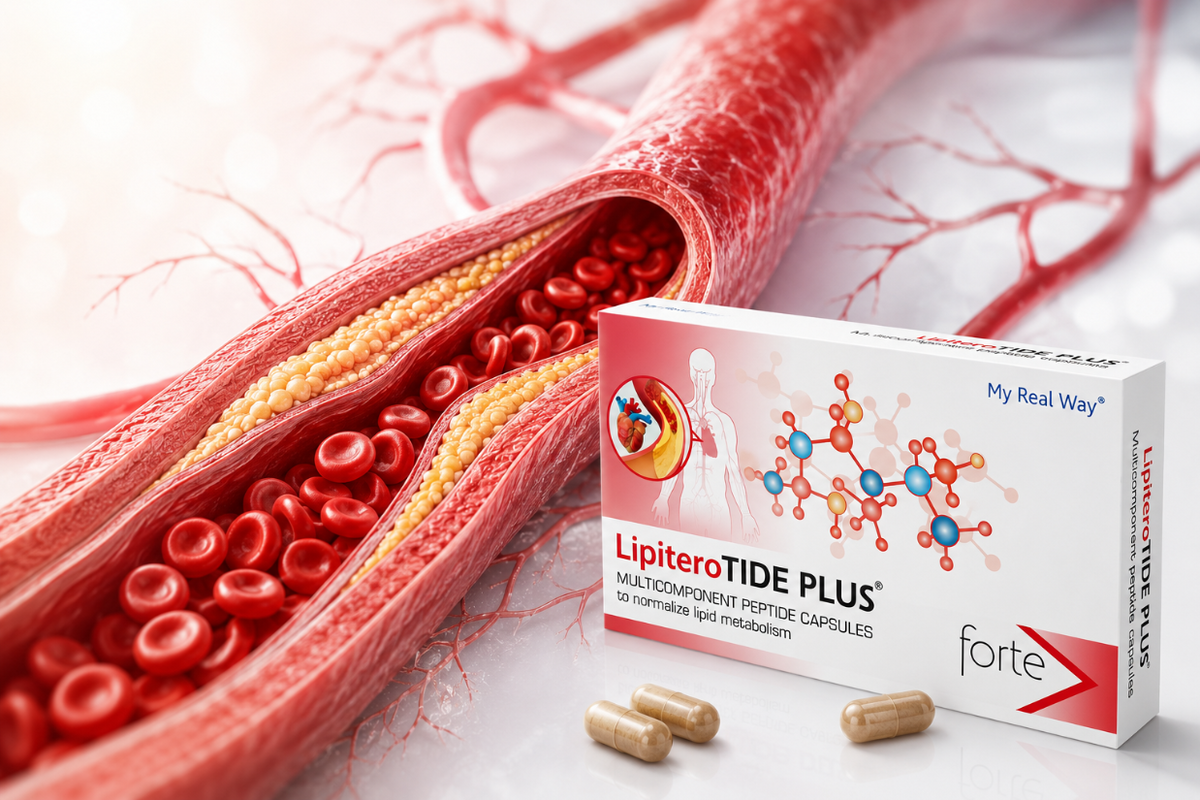
How LipitorTIDE PLUS forte contributes to lipid balance
LipitorTIDE PLUS forte is a dietary supplement designed to support normal cholesterol and lipid metabolism. The natural peptides and biologically active components contained in it help to maintain normal metabolic processes.
Main components:
- Peptide complex – supports cell functions.
- Red rice extract (monacolin K).
- Berberine hydrochloride.
- Terminalia bellirica fruit extract.
- Folic acid.
This complex may be beneficial for people who care about the balance of their cardiovascular system.
Can you eat foods with cholesterol?
Yes. For most people, animal products do not significantly affect LDL levels. What is more important is the overall nutritional context .
When are medications needed?
Medications may be prescribed if:
- had a heart attack or stroke,
- is diabetes,
- very high LDL,
- familial hypercholesterolemia was detected.
The decision is always made by the doctor.
Conclusion
Cholesterol is not a threat, but a natural and necessary part of life . The risk arises not from its existence, but from a lifestyle that unbalances the body's systems.
Self-care, regular checkups, a balanced diet, and conscious decisions allow you to maintain a healthy balance and long-term well-being.
